Summary
Harness Tailor is a robotic solution designed to automate the manufacturing of cable harnesses—cutting down time and cost. Think of it as a 3D printer for wires.
The system is supplied with cable drums, connectors, and various insulation materials (electric, thermal, or electromagnetic). A coordinated robotic setup then performs the complete harness assembly process:
- ConBot places connectors on a programmable workbench.
- CrimpBot selects wires by color and size, cuts them to length, crimps terminals, and places them along a predefined path.
- Optional modules test the harness and apply tape or covers.
Key Applications:
- Mass production of customized harnesses for any vehicle type, all from a single manufacturing setup.
- R&D prototyping, enabling rapid iteration on different designs, insulation types, and routing strategies.
- Pre- or post-assembly testing of connectivity, resistance, and electromagnetic interference.
System Components
1. Workbench Table
The workbench forms the core of the Harness Tailor system. It defines the position of connectors and wire routing. Key modules—wire holders, ConBot, and the tape robot—are mounted on or beneath the table surface.
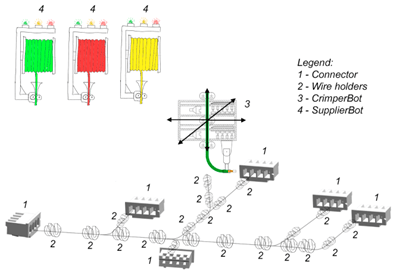
Fig. 2.1 Workbench Table
2. Wire Holders
These mechanical clamps secure the wires along the defined path. Each holder acts like a claw: it opens during wire placement and closes afterward to keep the wire in position. This enables precise laying of wires in complex shapes and orientations.
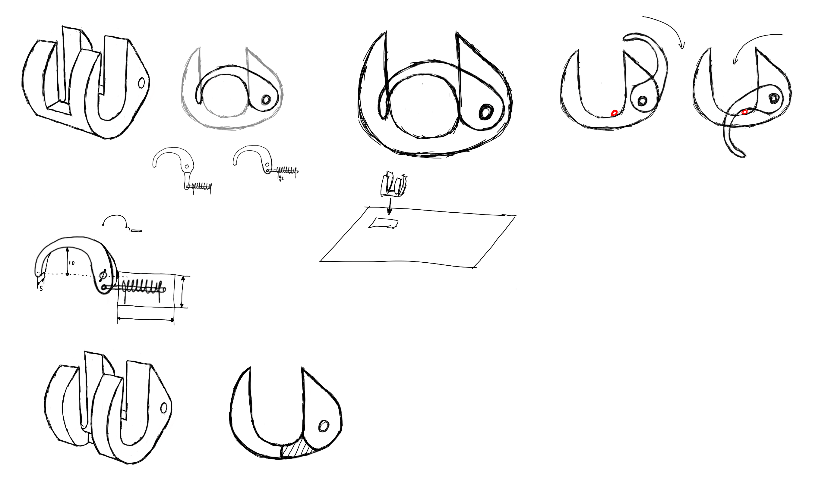
Fig. 2.2 Wire Holders
3. ConBot – Connector Robot
A simple robotic arm or actuator system that places connectors at the programmed points on the workbench. This could range from a robotic placement arm to a semi-manual mechanism depending on configuration.
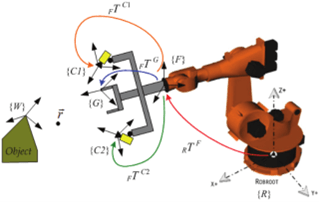
Fig. 2.3 Connector Positioning Robot
4. Wire Supplier
An electronically controlled feeder that delivers wires to the CrimpBot. Each feeder is tailored to a specific wire color and diameter. It supports both forward (supply) and backward (retract) motion to manage slack and precise wire delivery.
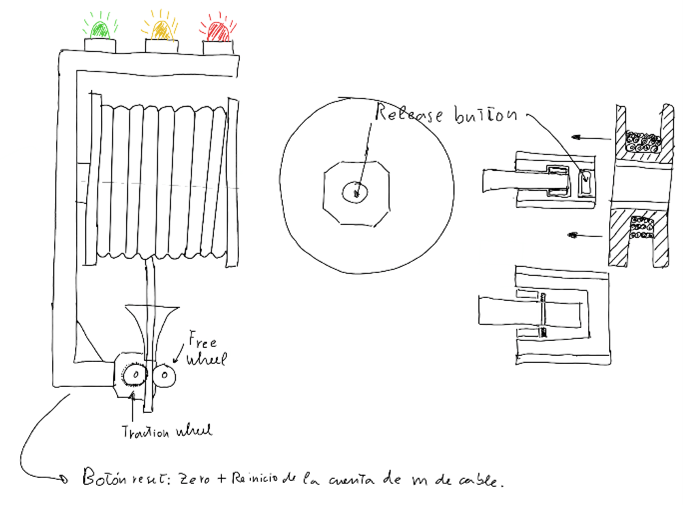
Fig. 2.4 Wire Supplier
5. CrimpBot – Wiring Robot
The CrimpBot handles:
- Cutting wires to precise lengths
- Crimping terminals at both ends
- Routing the wire through the 3D workspace
- Inserting wires into correct pins of the connectors
It operates using a 3D motion control system and performs all wiring tasks autonomously.
Fig. 2.5 Video of CrimpBot in action
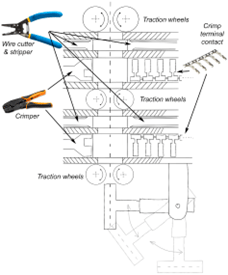
Fig. 2.6 CrimpBot Scheme
6. Test Unit
This module connects to the finished harness to validate:
- Electrical continuity
- Insulation resistance
- Electromagnetic interference protection
It ensures quality assurance before the harness leaves the workbench.
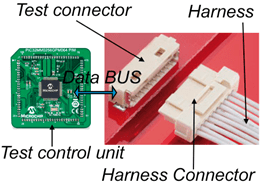
Fig. 2.7 Test Unit Scheme
7. Tape Robot
This robot wraps adhesive tape around wire bundles. It can:
- Wrap specific joints or Y-splits
- Cover full wire sections for added protection or bundling
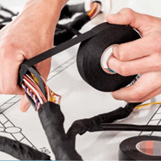
Fig. 2.8 Manual Tape Example
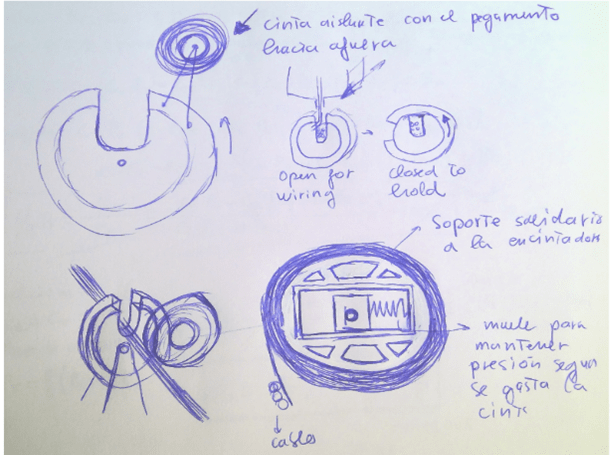
Fig. 2.9 Tape Robot Sketch
8. Harness Cover Robot
This robot installs corrugated tubing or protective sleeves along sections of the harness where needed. It automates a process typically done manually, increasing speed and precision.
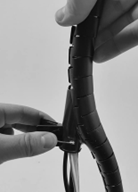
Fig. 2.10 Manual Example: Covering Cable with Corrugated Tube
Final Notes
Harness Tailor introduces a new era of smart, modular harness manufacturing. Its robotic approach enables:
- Flexibility in design
- Rapid iteration in development cycles
- Scalable production for high or low volumes
With the right configuration, this system can replace traditional manual processes and revolutionize how wiring is done in automotive, aerospace, and industrial sectors.
 Diario de un loco